How to write SEO friendly article – A Step by Step Guide
Published: 29 Dec 2025
Did you know that more than 90% of online experiences start with a search engine? Today, I will personally guide you onhow to write SEO friendly article using proper seo technuques that not only ranks highly on Google but also attracts the right audience. By following my steps, you’ll learn to create articles that are both informative and easy to find online, even if you are a beginner. To get started, check out our detailed guide on SEO friendly article writing tools that can help you write better and rank higher.
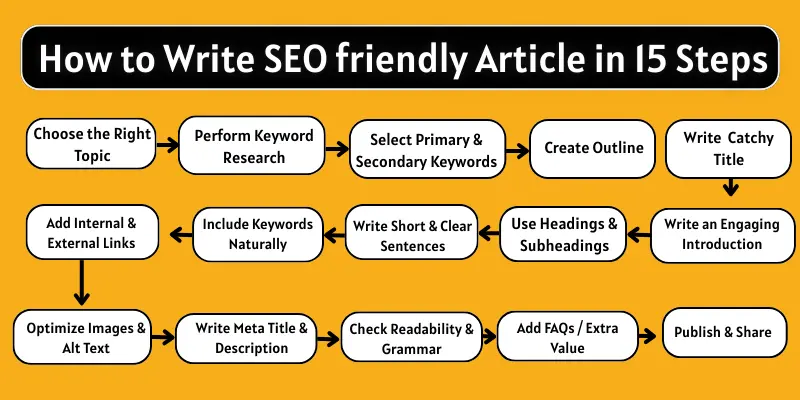
15 steps on how to write SEO friendly article
Writing content that ranks on Google doesn’t have to be difficult. In this guide, I will show you 15 simple steps on how to write SEO friendly content so your articles get noticed and reach the right audience.
- Choose the Right Topic
- Perform Keyword Research
- Select Primary and Secondary Keywords
- Create a Clear Article Outline
- Write a Catchy Title (H1)
- Write an Engaging Introduction
- Use Headings and Subheadings (H2, H3)
- Write Short, Simple, and Clear Sentences
- Include Keywords Naturally in Content
- Add Internal and External Links
- Optimize Images and Alt Text
- Write Meta Title and Meta Description
- Check Readability and Grammar
- Add FAQs or Extra Value Sections
- Publish and Share
1. Choose the Right Topic
First, decide what you want to write about. Think about your readers and their problems. Choose a topic that helps them. Do not choose a very big topic. Pick one clear idea that is easy to explain.
Example:
- Topic: How to Write SEO Friendly Content
- Topic: Easy Computer Tips for Beginners

2. Perform Keyword Research
Now, find keywords for your topic. Keywords are the words people type in Google. These words help Google understand your article. Use simple tools to find keywords. Look for words with good searches. Avoid tough keywords. Long keywords work better for beginners.
Tools you can use:
- Google Keyword Planner
- Ubersuggest
- SEMrush
- Ahrefs
Examples:
- Topic: How to Write SEO Friendly Content
- Keywords: how to write seo friendly content, seo content writing, seo writing for beginners

3. Select Primary and Secondary Keywords
After keyword research, choose your main keywords. The primary keyword is the most important word. It tells Google what your article is about. Use only one primary keyword for one article. This keeps your content clear and focused.
Secondary keywords support the main keyword. They are similar words or phrases. These words help Google better understand your topic. Use a few secondary keywords. Add them naturally in your content.
Example:
- Topic: How to Write SEO Friendly Content
- Primary Keyword: How to write seo friendly content
- Secondary Keywords: seo content writing, seo writing tips, seo writing for beginners
Easy Tip
- One article = One primary keyword
- One article = 3–5 secondary keywords
4. Create a Clear Article Outline
Before you start writing, make a simple plan. This plan is called an outline. An outline helps you know what to write first and what to write next. It keeps your article clean and easy to read. When you follow an outline, you do not miss any important point. It also helps Google understand your content better.
Start with an introduction. Then add main headings. Under each heading, write small points. End your article with a conclusion. This makes your article strong and well-organized.
Example Outline:
- Introduction
- What is SEO Friendly Content
- Why SEO Friendly Content is Important
- Steps to Write SEO Friendly Content
- Common Mistakes
- FAQs
- Conclusion
Easy Tip
- First plan
- Then write
- Do not write without an outline
5. Write a Catchy Title (H1)
The title is the first thing people see. A good title makes people click. It also tells Google what your article is about. Always add your main keyword in the title. Keep the title short and clear. Do not use hard words. Make it easy to read.
Your title should explain the topic in one line. It should sound helpful. It should match what you write in the article.
Examples:
- How to Write SEO Friendly Content (Step-by-Step Guide)
- How to Write SEO Friendly Content for Beginners
- How to Write SEO Friendly Content That Ranks on Google
Easy Tip
- One article = one title
- Always add the main keyword
- Keep it simple and clear

6. Write an Engaging Introduction
The introduction is the start of your article. It tells readers what the article is about. A good introduction makes readers stay. Write in a friendly way. Talk directly to the reader. Add your primary keyword naturally in the first lines.
Keep the introduction short. Do not explain everything here. Just tell readers what they will learn. Make them curious to read more.
Examples:
- In this article, I will show you how to write SEO friendly content step by step. This guide is simple and easy for beginners.
- Learning how to write SEO friendly content helps your article reach more people. In this guide, I will explain everything in easy words.
Easy Tip
- Keep it short
- Use friendly words
- Add the main keyword once
7. Use Headings and Subheadings (H2, H3)
Headings and subheadings make your article easy to read. They help readers see what each part is about. Headings are H2. Subheadings are H3. Use your main keyword in at least one heading. Use secondary keywords in subheadings.
Break your content into small sections. Each section should cover one idea. This helps readers and Google understand your article better.
Examples:
- H2: Steps to Write SEO Friendly Content
- H3: Choose the Right Topic
- H3: Perform Keyword Research
- H2: Common Mistakes to Avoid
- H2: FAQs
Easy Tip
- Use headings for main points
- Use subheadings for details
- Keep headings short and clear.
8: Write Short, Simple, and Clear Sentences
Keep your sentences short. Do not use long or hard words. Short sentences are easy to read. They help your readers understand quickly. Use active voice to make your writing strong. Write in simple words that everyone can understand.
Break big ideas into small sentences. Use one idea in each sentence. This makes your article friendly and easy to follow.
Examples:
- Bad: Writing SEO friendly content can be a very difficult task for beginners because it requires understanding many different techniques and strategies.
- Good: Writing SEO friendly content is easy. Follow these steps. Beginners can do it too.
Easy Tip
- Use short sentences
- Use simple words
- One idea in one sentence
9: Include Keywords Naturally in Content
Use your primary and secondary keywords in the article. Do not force them. Write them where they fit naturally. Google reads your keywords to understand your content. Using keywords correctly helps your article rank better.
Do not repeat keywords too much. Use them in headings, subheadings, and a few sentences. Keep the writing smooth and natural.
Examples:
- Primary Keyword: How to write SEO friendly content
- Sentence: In this article, I will teach you how to write SEO friendly content step by step.
- Secondary Keyword: seo writing tips
- Sentence: Follow these seo writing tips to make your article better.
Easy Tip
- Use the main keyword once in the introduction
- Use secondary keywords in headings and body
- Write naturally, do not force
10. Add Internal and External Links
Links make your article more useful. Internal links connect to other pages on your website. They keep readers on your site longer. External links connect to other websites. They give extra information. Google likes articles with good links.
Use links naturally. Do not add too many links.
Examples:
- Internal link: Read our guide on “How to Write SEO Friendly Content” for more tips.
- External link: Learn more about SEO from Google’s official guide.
Easy Tip
- Add 2–3 internal links
- Add 1–2 external links
- Only link where it helps

11. Optimize Images and Alt Text
Images make your article interesting. They help readers understand better. Always compress images to keep your page fast. Add alt text to every image. Alt text tells Google what the image is about. It also helps people who cannot see the images.
Write alt text in simple words. Use your main or secondary keyword if it fits naturally. Do not overuse keywords.
Examples:
- Image: a computer writing article
- Alt text: Person writing SEO friendly content on a laptop
- Image: healthy breakfast
- Alt text: Easy healthy breakfast ideas for kids
Easy Tip
- Use 2–3 images per article
- Add clear alt text
- Keep image size small

12. Write Meta Title and Meta Description
The meta title and description appear in Google search. They tell readers what your article is about. Write a short and clear meta title. Add your main keyword in the title.
Write a meta description in 150–160 characters. Use simple words. Add your primary keyword naturally. Make it interesting so people click on your article.
Examples:
- Meta Title: How to Write SEO Friendly Content – Easy Guide for Beginners
- Meta Description: Learn how to write SEO friendly content step by step. This guide is easy and perfect for beginners.
Easy Tip
- Meta title: 50–60 characters
- Meta description: 150–160 characters
- Add the primary keyword in both
13. Check Readability and Grammar
Before publishing, read your article carefully. Make sure sentences are easy to read. Check for grammar mistakes and spelling errors. Use short words and simple sentences. This makes your article clear and friendly for readers.
You can also use tools to check readability. A good article is easy to understand and flows naturally.
Examples:
- Hard: SEO-friendly content writing requires an understanding of multiple techniques, which beginners may find challenging.
- Easy: Writing SEO friendly content is simple. Follow these steps. Beginners can do it too.
14. Add FAQs or Extra Value Sections
Adding FAQs helps readers find answers quickly. It also makes your article more helpful. You can add tables, charts, or examples to clearly explain points. Extra sections make your article longer and useful. Google also likes articles with extra value.
Write questions that beginners usually ask. Give short and clear answers. Keep it simple and friendly.
Examples:
- Question: What is SEO friendly content?
Answer: SEO friendly content is content that is easy to read and ranks well on Google. - Question: How long should an article be?
Answer: An article should have enough information. Usually, 800–1500 words is good for beginners.
Easy Tip
- Add 3–5 FAQs
- Use simple words
- Include helpful tips or examples.

15. Publish and Share
After writing, check your article one last time. Make sure it is clear and easy to read. Then publish it on your website or blog.
Share your article on social media. You can also send it to friends or groups who may find it useful. Sharing helps more people read your article.
Examples:
- Share on Facebook or Instagram.
- Post a link in WhatsApp groups.
- Send it to friends via email.
Easy Tip
- Always check before publishing
- Share with your audience
- Update your article if needed
Conclusion
So, friends, we are almost done. In this guide, we have covered how to write SEO friendly content in detail. I recommend that you start practicing these steps in your own articles. The more you practice, the better your writing and SEO skills will become. Start writing today and see your content reach more readers!
FAQs about seo friendly content writing
SEO friendly articles get more traffic from search engines. They help readers find your content easily. Writing SEO content also makes your blog more professional.
There is no strict rule, but 800-1500 words works well for beginners. Focus on covering the topic clearly. Always provide useful information to your readers.
Add your main keyword in the title and introduction. Use it in headings and a few sentences in the body. Add secondary keywords naturally in subheadings or examples.
Headings organize your article into sections. They make content easy for readers and Google. Use H2 for main points and H3 for subpoints.
SEO content is written to rank well on Google. Normal content may be helpful but not optimized. SEO content uses keywords, headings, and links properly.

- Be Respectful
- Stay Relevant
- Stay Positive
- True Feedback
- Encourage Discussion
- Avoid Spamming
- No Fake News
- Don't Copy-Paste
- No Personal Attacks
- Be Respectful
- Stay Relevant
- Stay Positive
- True Feedback
- Encourage Discussion
- Avoid Spamming
- No Fake News
- Don't Copy-Paste
- No Personal Attacks
