Difference between on-page and off-page SEO
Published: 05 Jan 2026
Many websites fail to rank not because their content is harmful, but because SEO is done in the wrong way. Some people focus only on content, while others chase backlinks blindly. This confusion usually comes from not understanding the difference between on-page and off-page SEO, which plays a crucial role in improving visibility and search rankings.
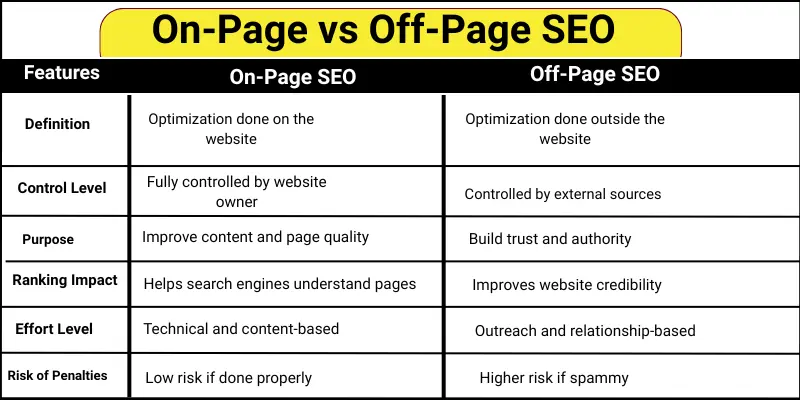
11 Differences between on-page and off-page SEO
Understanding the difference between on-page and off-page SEO is essential for building a strong SEO strategy. Both focus on improving rankings, but they work in very different ways.
- Definition Difference
- Control Level (Website Owner Control vs External)
- Purpose Difference
- Ranking Impact
- Cost Difference
- Time Required for Results
- Effort Level
- Risk of Penalties
- Technical Involvement
- Content Dependency
- Link Dependency
1. Definition
The difference between these types starts with their meaning. Both help websites rank on Google, but they work in different ways.
On-page SEO
In this, all the work you do on your own website. You write helpful content and use the right keywords. You improve titles, headings, and images to make pages clear. On-page SEO helps search engines understand your website better.
Off-page SEO
In this method, all the work is done outside your website. It mainly focuses on getting links from other websites. It builds trust and authority for your site. Off-page SEO tells search engines that your website is reliable and popular.
2. Control Level
In both types, the level of control is not the same.
On-page SEO
On-page SEO techniques give full control to the website owner. You can change content, keywords, titles, and images anytime you want. You decide how your pages look and work. On-page SEO depends completely on you.
Off-page SEO
Off-page SEO strategies depend on external websites. Other websites decide whether they link to you or mention your site. You can request links, but you cannot force them. Off-page SEO depends on others’ actions.
3. Purpose Difference
Both on-page and off-page SEO are important SEO ranking factors, but their purpose is different to improve website ranking.
On-page SEO
The main purpose of on-page SEO is to improve the quality of web pages. It helps make content clear, useful, and easy to read. On-page SEO focuses on helping search engines understand what a page is about. It also improves user experience on the website.
Off-page SEO
The main purpose of off-page SEO is to improve the reputation of a website. It helps show that other websites trust your site. Off-page SEO focuses on building authority and popularity online. It supports your website’s overall online image.
4. Ranking Impact
The on-page vs off-page SEO is also clear from how they affect rankings. Both help your website appear higher on Google, but in different ways.
On-page SEO
On-page SEO directly improves your page ranking. Good content, proper keywords, and clear headings help search engines understand your pages. It makes your website stronger for specific searches. On-page SEO gives fast signals to Google about your site.
Off-page SEO
Off-page SEO improves ranking indirectly. High-quality backlinks and mentions from other websites increase your site’s authority. Google sees these as votes of trust. Off-page SEO takes time, but it helps your website rank higher in the long term.
5. Cost Difference
Both require effort, but the amount of money needed differs.
On-page SEO
On-page SEO usually costs less. You mainly spend time writing content and fixing your website. Most changes you can do yourself without paying anyone. It is affordable for beginners and small websites.
Off-page SEO
Off-page SEO can cost more. Getting quality backlinks or promoting your site may require money. You might hire experts or pay for guest posts. Off-page SEO often needs investment for faster results.
6. Time Required for Results
In this method, some changes appear quickly, while others take time.
On-page SEO
On-page SEO gives results faster. When you update content, titles, or images, search engines notice it quickly. You can see improvement in a few days or weeks. It works well for immediate impact.
Off-page SEO
Off-page SEO takes longer to show results. Building backlinks, gaining mentions, and improving authority takes time. Google needs to see consistent trust signals. It usually takes months to see the full effect.
7. Effort Level
Both need work, but the effort required is different.
On-page SEO
On-page SEO needs regular effort on your website. You write content, add keywords, fix titles, and improve images. Most work you can do yourself. It is focused and easier to manage.
Off-page SEO
Off-page SEO needs effort outside your website. You must reach out to other sites, build backlinks, and get mentions. It often requires patience and communication. Off-page SEO is harder to control but builds long-term strength.
8. Risk of Penalties
The comparison between on-page and off-page SEO is also seen in the risk of penalties. Some SEO mistakes can hurt your website’s ranking.
On-page SEO
On-page SEO has low risk if you follow the rules. Using proper keywords, good content, and correct titles is safe. You control everything yourself, so mistakes are easy to fix. It keeps your site secure from penalties.
Off-page SEO
Off-page SEO has a higher risk if done incorrectly. Spammy links or low-quality backlinks can hurt your ranking. You do not fully control who links to you. Google may penalize your website for bad off-page practices.
9. Technical Involvement
In these types, some tasks need more technical work than others.
On-page SEO
On-page SEO needs more technical work on your website. You may fix page speed, mobile-friendliness, URLs, and headings. You also optimize images and internal links. It requires hands-on work with your site.
Off-page SEO
Off-page SEO needs less technical work. You focus on links, mentions, and building relationships. You do not change your website’s code. It is more about outreach and networking than technical skills.
10. Content Dependency
Some SEO types depend more on content than others.
On-page SEO
On-page SEO depends heavily on content. You need to write helpful articles, use the right keywords, and structure your pages well. Good content helps search engines understand your website. Without proper content, on-page SEO cannot work effectively.
Off-page SEO
Off-page SEO depends less on your website’s content. It focuses on backlinks, mentions, and authority from other sites. Even if your content is small, off-page SEO can still improve your website’s reputation. It supports the website from outside.
11. Link Dependency
Links play an important role in SEO. They help search engines and users understand your website. On-page and off-page SEO use links in very different ways.
On-page SEO
It mostly uses links inside your own website. You connect your pages so visitors can move easily and search engines can understand your site structure. These links help organize content but stay within your website.
Off-page SEO
It depends on links from other websites. Other sites linking to yours show that your content is trusted and important. These backlinks improve your website’s reputation and help it rank higher on Google. Without good off-page links, it is hard to gain authority online.
Which Is More Important: On-Page or Off-Page SEO?
Both on-page and off-page SEO are important for a website. You cannot rely only on one of them.
On-page SEO comes first because it makes your website strong and clear. Good content, proper keywords, and organized pages help search engines understand your site. Without on-page SEO, off-page efforts will not be very effective.
Off-page SEO strengthens your website’s authority and reputation. It helps other sites trust you and increases your ranking over time. When both on-page and off-page SEO work together, your website can rank higher and get more visitors.
Conclusion
So guys, it’s time to end! In this article, we’ve covered the difference between on-page and off-page SEO in detail. I personally recommend focusing on both types together. Strong on-page SEO makes your site clear and organized, while off-page SEO builds trust and authority. Start improving your website today and see the results for yourself!
FAQs about On-Page vs Off-Page SEO
Yes, on-page SEO should come first. It prepares your website with clear content and structure. Off-page SEO works better when the site is already optimized.
Off-page SEO can bring traffic, but weak content will not keep users. Visitors may leave quickly if content is poor. Strong content is needed for long-term success.
Yes, small websites also need both types. On-page SEO helps them look professional and clear. Off-page SEO helps them grow slowly and gain trust.
No, on-page SEO is not just about keywords. It also includes content quality, page structure, and user experience. All these work together to help rankings.
No, backlinks are important but not the only part. Brand mentions, shares, and online presence also matter. These signals help build trust.
Yes, bad off-page SEO can harm your site. Spammy or low-quality links can reduce trust. Always focus on quality instead of quantity.
No, on-page SEO needs regular updates. Content should stay fresh and useful. Search engines prefer updated and relevant pages.
Off-page SEO helps, but it does not give instant results. New websites need time to gain trust. Consistent effort brings better results.
No, stopping completely is not a good idea. Competitors may continue building authority. Regular off-page work helps maintain rankings.

- Be Respectful
- Stay Relevant
- Stay Positive
- True Feedback
- Encourage Discussion
- Avoid Spamming
- No Fake News
- Don't Copy-Paste
- No Personal Attacks
- Be Respectful
- Stay Relevant
- Stay Positive
- True Feedback
- Encourage Discussion
- Avoid Spamming
- No Fake News
- Don't Copy-Paste
- No Personal Attacks
