Market Research Techniques – 12 Proven Methods to Understand Customers in 2026
Published: 09 Jul 2026
In today’s competitive business environment, making decisions based on assumptions can be costly. Customer preferences change quickly, new competitors enter the market regularly, and industry trends evolve faster than ever.
This is where market research becomes essential.
Market research helps businesses collect valuable information about their customers, competitors, and industry. It allows companies to understand what customers want, identify market opportunities, reduce risks, and make smarter business decisions.
Whether you’re launching a new product, improving a marketing campaign, or expanding into a new market, using the right market research techniques can help you make data-driven decisions instead of relying on guesswork.
In this guide, you’ll learn the most effective market research techniques businesses use in 2026 to better understand their audience and stay ahead of the competition.
What Is Market Research?
Market research is the process of collecting, analyzing, and interpreting information about a target market, customers, competitors, and industry trends.
The goal is simple: understand the market before making important business decisions.
Businesses conduct market research to answer questions such as:
- Who are my customers?
- What problems do they face?
- What products or services do they need?
- What are competitors doing?
- How can I improve my marketing strategy?
The insights gained from market research help businesses create products, services, and marketing campaigns that better meet customer needs.
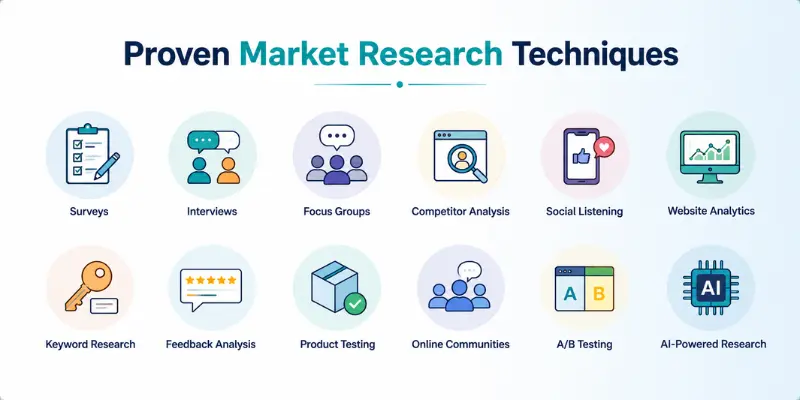
Top 12 Market Research Techniques method
Here is the complete guide on Market Research methods, which are as follows
1. Online Surveys
Online surveys are one of the most widely used market research techniques. Businesses create questionnaires and distribute them through email, websites, social media, or survey platforms to collect feedback from customers.
Surveys help organizations gather opinions, preferences, buying habits, and satisfaction levels from a large audience in a relatively short time.
Best For
- Customer satisfaction research
- Product feedback
- Brand awareness studies
- Audience preferences
Advantages
- Cost-effective
- Reaches large audiences quickly
- Easy to analyze data
- Suitable for quantitative research
Limitations
- Low response rates
- Limited opportunity for follow-up questions
- Responses may not always be accurate
2. Customer Interviews
Customer interviews involve direct one-on-one conversations with existing or potential customers. These discussions help businesses understand customer experiences, motivations, frustrations, and expectations in greater detail.
Unlike surveys, interviews allow researchers to ask follow-up questions and explore topics more deeply.
Best For
- Understanding customer behavior
- Discovering pain points
- Product development research
- Customer journey analysis
Advantages
- Detailed insights
- Rich qualitative data
- Better understanding of customer emotions
Limitations
- Time-consuming
- Smaller sample size
- Requires skilled interviewers
3. Focus Groups
A focus group is a guided discussion involving a small group of participants who represent the target audience. A moderator leads the conversation and gathers opinions about products, services, advertisements, or business ideas.
The interaction between participants often reveals insights that may not emerge during individual interviews.
Best For
- Product testing
- Advertising feedback
- Brand perception studies
- Concept validation
Advantages
- Encourages open discussion
- Generates diverse opinions
- Provides immediate feedback
Limitations
- Small participant groups
- Dominant personalities may influence results
- Findings may not represent the entire market
4. Competitor Analysis
Competitor analysis involves studying competing businesses to understand their products, pricing, marketing strategies, customer engagement, and market positioning.
This technique helps companies identify strengths, weaknesses, opportunities, and market gaps.
Best For
- Market positioning
- Strategic planning
- Product improvement
- Identifying opportunities
Advantages
- Reveals industry trends
- Highlights competitive advantages
- Supports informed decision-making
Limitations
- Competitor data may be limited
- Strategies can change frequently
- Doesn’t directly reflect customer opinions
5. Social Media Listening
Social media listening is the process of monitoring online conversations about a brand, product, industry, or competitor across social platforms.
Businesses use social listening tools to track mentions, hashtags, customer feedback, and emerging discussions.
Best For
- Brand reputation management
- Trend identification
- Customer sentiment analysis
- Competitive monitoring
Advantages
- Real-time insights
- Access to authentic customer opinions
- Early trend detection
Limitations
- Large volumes of data
- Requires ongoing monitoring
- Not all conversations are relevant
6. Website Analytics
Website analytics helps businesses understand how visitors interact with their websites. Data such as page views, bounce rates, traffic sources, and user behavior provide valuable market insights.
Modern analytics platforms allow businesses to track customer journeys and identify opportunities for improvement.
Best For
- Understanding online behavior
- Conversion optimization
- Audience analysis
- Content performance evaluation
Advantages
- Data-driven insights
- Continuous monitoring
- Helps improve user experience
Limitations
- Doesn’t explain customer motivations
- Requires analytical skills
- Data interpretation can be complex
7. Keyword Research
Keyword research helps businesses identify the terms and phrases people use when searching online. It reveals customer interests, problems, questions, and buying intent.
In 2026, keyword research has become one of the most valuable digital market research techniques because it reflects real consumer demand.
Best For
- Content planning
- SEO strategy
- Demand analysis
- Product idea validation
Advantages
- Reveals search intent
- Identifies market opportunities
- Supports content marketing
Limitations
- Search volume alone doesn’t guarantee sales
- Requires proper keyword analysis
8. Customer Feedback Analysis
Customer feedback analysis involves collecting and evaluating reviews, surveys, support tickets, emails, social media comments, and customer complaints. Businesses use this information to understand customer satisfaction levels and identify areas for improvement.
Since the feedback comes directly from customers, it often provides some of the most valuable market insights.
Best For
- Improving products and services
- Measuring customer satisfaction
- Identifying common problems
- Enhancing customer experience
Advantages
- Direct customer insights
- Helps improve customer retention
- Identifies strengths and weaknesses
- Supports better decision-making
Limitations
- Feedback can be biased
- Negative feedback may be overrepresented
- Requires proper analysis
9. Product Testing
Product testing involves allowing selected users to try a product before its official launch. Researchers gather feedback about functionality, usability, design, performance, and customer satisfaction.
This technique helps businesses identify potential issues before releasing a product to the broader market.
Best For
- New product launches
- Product improvements
- Feature validation
- Quality assurance
Advantages
- Reduces launch risks
- Identifies product flaws early
- Improves customer satisfaction
- Provides real-world feedback
Limitations
- Can be time-consuming
- Requires participant recruitment
- Limited testing groups may not represent the entire market
10. Online Community Research
Online community research involves studying discussions within forums, Facebook groups, Reddit communities, LinkedIn groups, and niche industry platforms.
These communities often contain honest conversations about customer needs, frustrations, preferences, and emerging trends that traditional research methods may miss.
Best For
- Audience research
- Trend discovery
- Product idea generation
- Customer pain point analysis
Advantages
- Access to authentic discussions
- Cost-effective research method
- Identifies emerging trends
- Reveals customer language and terminology
Limitations
- Information may be unstructured
- Not all opinions represent the broader market
- Requires manual analysis
11. A/B Testing
A/B testing is a market research technique used to compare two versions of a webpage, advertisement, email, landing page, or product feature. Researchers measure performance differences to determine which version produces better results.
Rather than relying on assumptions, businesses use real user behavior to make decisions.
Best For
- Marketing campaigns
- Landing page optimization
- Email marketing
- Conversion rate improvement
Advantages
- Data-driven decision making
- Improves marketing performance
- Reduces guesswork
- Provides measurable results
Limitations
- Requires sufficient traffic
- Small sample sizes may produce inaccurate results
- Testing can take time
12. AI-Powered Market Research
AI-powered market research uses artificial intelligence to analyze large datasets, identify patterns, predict trends, and generate insights faster than traditional methods.
In 2026, businesses will increasingly use AI tools to process customer feedback, monitor market trends, analyze competitors, and forecast consumer behavior.
Best For
- Large-scale data analysis
- Predictive market research
- Customer sentiment analysis
- Trend forecasting
Advantages
- Faster data processing
- Identifies hidden patterns
- Supports predictive insights
- Handles massive datasets efficiently
Limitations
- Depends on data quality
- May require specialized tools
- Human interpretation is still necessary
Which Market Research Technique Is Best?
There is no single best market research technique because every business has different goals.
- Use online surveys when you need feedback from a large audience.
- Choose customer interviews for deeper insights.
- Use focus groups to explore opinions and reactions.
- Conduct competitor analysis to understand market positioning.
- Apply social media listening to monitor trends and customer sentiment.
- Leverage AI-powered research when analyzing large volumes of data.
The most successful companies often combine multiple market research techniques to gain a complete understanding of their market, customers, and competitors
Conclusion
Market research techniques help businesses understand their customers, competitors, and overall market conditions before making important decisions. From online surveys and customer interviews to competitor analysis and AI-powered research, each technique provides unique insights that can reduce risks and improve business outcomes.
The key is choosing the right method based on your goals. While some techniques help you collect direct customer feedback, others reveal market trends, consumer behavior, and growth opportunities. In 2026, businesses that combine multiple market research techniques are better equipped to create products, improve customer experiences, and stay ahead of the competition.
By applying the techniques discussed in this guide, you can make more informed decisions, identify new opportunities, and build strategies based on real data rather than assumptions.
FAQs about market research techniques
Some of the most effective techniques include surveys, customer interviews, competitor analysis, social media listening, keyword research, and AI-powered research. The best choice depends on your goals and audience.
Primary research collects original data directly from customers, while secondary research uses existing information from reports, studies, and public sources.
AI helps businesses analyze large amounts of data, identify trends, monitor customer sentiment, and generate insights much faster than traditional research methods.
The four main types of market research are primary research, secondary research, qualitative research, and quantitative research. Each type helps businesses gather different kinds of information based on their objectives.
The first step is defining a clear research objective. Businesses should identify what information they need before selecting the most appropriate market research techniques and tools.
Market research methods are broader approaches, such as primary and secondary research. Market research techniques are the specific tools and activities used within those methods, such as surveys, interviews, and focus groups.

- Be Respectful
- Stay Relevant
- Stay Positive
- True Feedback
- Encourage Discussion
- Avoid Spamming
- No Fake News
- Don't Copy-Paste
- No Personal Attacks
- Be Respectful
- Stay Relevant
- Stay Positive
- True Feedback
- Encourage Discussion
- Avoid Spamming
- No Fake News
- Don't Copy-Paste
- No Personal Attacks
